AC Sizing & Running-Cost Calculator
Most people buy the wrong size. Dial in your room below and watch the recommendation update live — including the AC type that fits and what it'll cost to run each month.
Your room
A standard window or portable AC is the cheapest fit for a room this size. Estimated at 8 hrs/day and 0.14 $/kWh — roughly 194 kWh per month.
3 units matched to your room
Compare all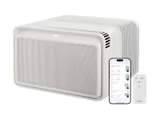
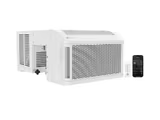
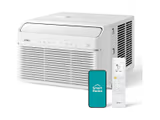
How we calculate this
We start from the ENERGY STAR sizing table — interpolated for your exact square footage, since cooling load isn't linear in floor area (small rooms need ~33 BTU/ft², large rooms ~16) — then adjust for ceiling height, sun exposure, insulation, occupancy, kitchen heat, and your climate zone. Running cost assumes an EER of 10.5 and your zone's average electricity rate. It's a strong starting estimate — a licensed pro can do a full Manual J load calculation for installs.
How to size an air conditioner
Sizing comes down to four things: how big the room is, your climate, how much heat the room gains, and how efficiently you want to run it. Here is the short version the calculator above automates.
- 1
Measure your room
Multiply length × width for the square footage. The baseline cooling load is about 20 BTU per square foot.
- 2
Choose your climate zone
Hot, humid regions need roughly 10–15% more capacity and hot-dry desert about 8% more; cool-north regions need a little less. The calculator applies the right multiplier automatically.
- 3
Adjust for sun, insulation, and ceiling height
A sun-drenched, poorly insulated room with high ceilings needs more BTU; a shaded, well-insulated room needs less.
- 4
Read your recommendation and running cost
You get a target BTU range, the AC type that fits, and an estimated monthly running cost at your state’s electricity rate.
AC sizing FAQs
How many BTU do I need per square foot?
A common rule of thumb is about 20 BTU per square foot for a standard room — so a 300 ft² room is roughly 6,000 BTU at baseline. Climate, sun, insulation, and ceiling height move that meaningfully, which is what the calculator accounts for.
Does my climate change the BTU I need?
Yes. Hot, humid regions push cooling loads about 10–15% above the baseline, hot-dry desert about 8%, and cool-north regions slightly below it. Select your climate zone and the calculator applies the multiplier.
What happens if my AC is too big?
An oversized unit short-cycles: it cools the air quickly, shuts off, and never runs long enough to pull out humidity — leaving the room cold but clammy. Right-sizing (or an inverter unit that runs low and steady) beats buying the biggest unit.
How much does it cost to run an AC?
It depends on the unit’s efficiency, your local electricity rate, and hours of use. An efficient 12,000 BTU unit runs roughly $20–60 a month at 8 hours a day depending on your state’s rate — the calculator estimates this for your situation.