The short answer
Most people spend $25–60 a month to run a single-room air conditioner about eight hours a day. A small 5,000 BTU window unit can be under $15 a month; a large 14,000 BTU unit running long days in a hot, pricey market can top $80. An efficient inverter mini-split typically costs noticeably less than a comparable window unit.
Three things decide your number: the unit's wattage (driven by its size and efficiency), how many hours a day it runs, and your local electricity rate. The BTU calculator estimates the monthly cost for your exact room and state.
The formula: watts × hours × rate
Running cost comes down to one calculation. Take the unit's power draw in watts, divide by 1,000 to get kilowatts, multiply by hours run per day, then by your electricity rate in dollars per kilowatt-hour (kWh):
(watts ÷ 1,000) × hours per day × rate per kWh = daily cost. Multiply by 30 for a monthly estimate.
Example: a 10,000 BTU window unit drawing about 900 watts, run 8 hours a day at the US average rate of roughly $0.17/kWh, costs about $1.22 a day — close to $37 a month. Swap in your own unit's wattage (on its label or spec sheet) and your local rate to personalize it.
Estimated monthly cost by AC size
At roughly 8 hours a day and the US average rate (about $0.17/kWh), here is what typical units cost to run per month. Efficient inverter models sit at the low end of each range; older fixed-speed units at the high end:
5,000 BTU (small bedroom): about $8–18/month. 8,000 BTU (medium room): about $15–30. 10,000 BTU (large room): about $22–40. 12,000 BTU (open living area or mini-split): about $25–48. 14,000 BTU (large open space): about $32–60.
Run the unit 12 or more hours a day in a hot climate and these figures rise accordingly — which is exactly why efficiency and right-sizing matter most in long-season states.
What moves your bill the most
Efficiency. The unit's SEER2 (mini-splits) or CEER (window units) rating is the biggest lever you control at purchase. A high-SEER2 inverter unit can use a third less power than a budget unit of the same size — see our explainer on what SEER2 and CEER mean.
Your electricity rate. Rates range from around $0.11/kWh in the cheapest states to over $0.30 in California and parts of the Northeast — nearly a 3× spread for the identical unit. Our AC costs by state pages use each state's real average rate.
Sizing and runtime. An oversized unit short-cycles and wastes energy; an undersized one runs nonstop. Right-sizing with the BTU calculator keeps runtime — and cost — where it should be.
How to lower your AC running cost
A few high-impact moves: choose an inverter or high-SEER2 model (the efficiency premium pays back fastest in hot, high-rate states); right-size the unit to the room so it does not short-cycle; set the thermostat a couple of degrees higher and let a fan do the rest; and keep the filter and coils clean so the system never works harder than it needs to.
Over a full season those habits routinely save $50–150 versus running an old, oversized unit — more in a long-cooling-season state.
Cost by state
Because rates and cooling seasons vary so much, the same unit can cost four times as much to run in one state as in another. For the full ranking — every state's monthly cost computed from the latest EIA electricity rates — see what a window AC adds to your bill in every state, and for sizing plus running costs specific to your state, the AC costs by state pages each calculate at that state's average rate.
Featured units
Specs and running costs for the units referenced in this guide:
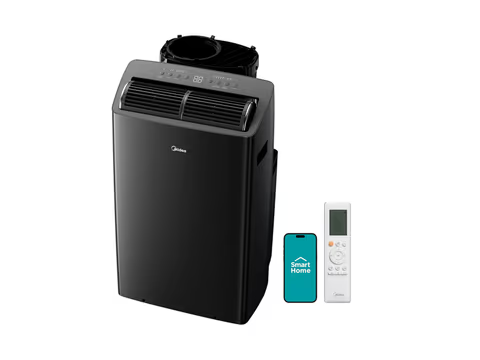
Midea Duo MAP12S1TBL-A
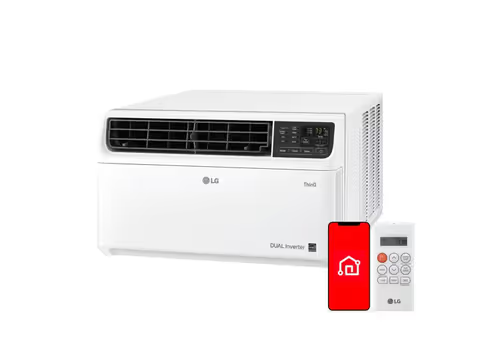
LG Dual Inverter LW1022IVSM
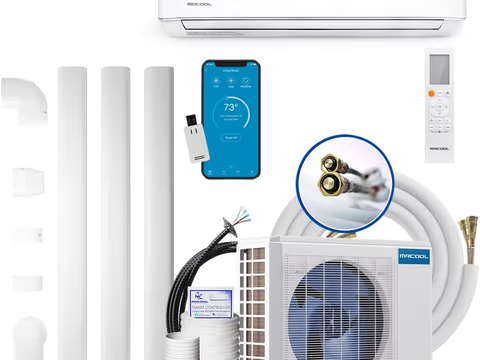
MRCOOL DIY 4th Gen 12K
Frequently asked questions
How much does it cost to run an AC per month?
Most single-room air conditioners cost about $25–60 a month run roughly 8 hours a day, though a small 5,000 BTU unit can be under $15 and a large 14,000 BTU unit in a hot, high-rate market can top $80. Efficiency, your electricity rate, and how many hours you run it are the main drivers.
Does running the AC 24/7 cost a lot?
It adds up: tripling runtime from 8 to 24 hours roughly triples the cooling part of your bill. An efficient inverter unit holding a steady temperature is far cheaper to run long hours than an older fixed-speed unit that blasts and short-cycles, so efficiency matters most if you run it around the clock.
Is it cheaper to leave the AC on or turn it off when I leave?
For most homes, setting the temperature up a few degrees while you are out beats turning it fully off and re-cooling a hot space later — especially with an efficient inverter unit that modulates rather than blasting. Turning it off entirely only wins on short, mild days.
How much does a mini-split cost to run?
Less than a comparable window unit — often 30–50% less than an older fixed-speed model — because its variable-speed inverter compressor runs long and low at a high SEER2 rating. A 12,000 BTU mini-split commonly runs in the $20–40/month range at average rates and typical use.
Which type of AC is cheapest to run?
A high-SEER2 inverter mini-split is the cheapest per unit of cooling, followed by an inverter window unit. Older fixed-speed window and portable units cost the most. Whatever the type, a right-sized unit always beats an oversized one, which wastes energy short-cycling.
Not sure what size you need?
Our calculator factors in climate, sun, and insulation — and estimates your monthly running cost.
Run the BTU calculator
-480x360.avif)