The short answer
Choose a through-the-wall unit when you cannot or will not give up a window — an existing sleeve, a rental rule, a view you refuse to block, or a room with no window that fits a bracket. Choose a window unit for everything else, because the best of them are dramatically more efficient and quieter than any wall unit on the market.
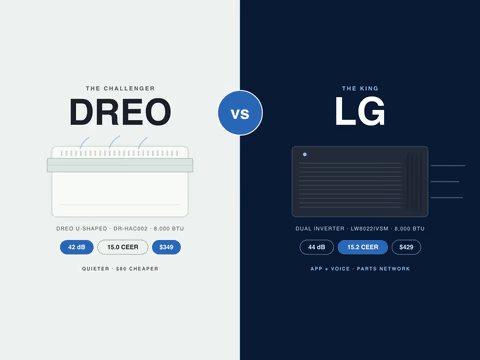
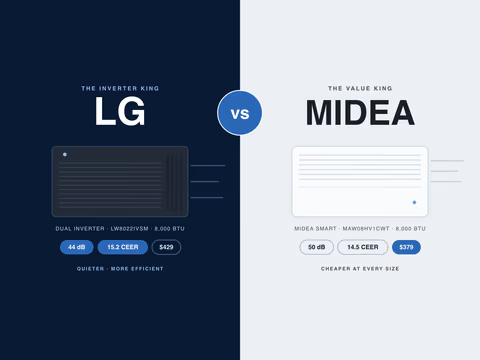
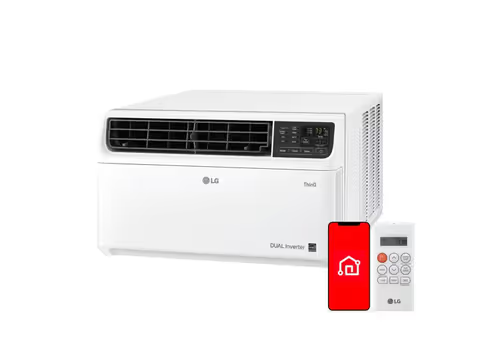
The numbers are not close. Our six through-the-wall units span 9.5–10.6 CEER and 54–62 dB. The LG LW1022IVSM window inverter is 15.0 CEER at 44 dB — about 40% less electricity for the same cooling, and roughly half as loud. The wall unit’s case rests entirely on installation and permanence, and for some homes that case is decisive.
What actually differs: the sleeve, the vents, and the wall
A window AC hangs in the open sash on a bracket and vents through side louvers. A through-the-wall AC slides into a metal sleeve set into the exterior wall and vents straight out the back — which is why the two are not interchangeable: side louvers would be blocked inside a sleeve. The sleeve is almost always sold separately (both the Koldfront WTC8001W and the Friedrich note this), and it is the permanent part: you cut the wall once, and the hole outlives several units.
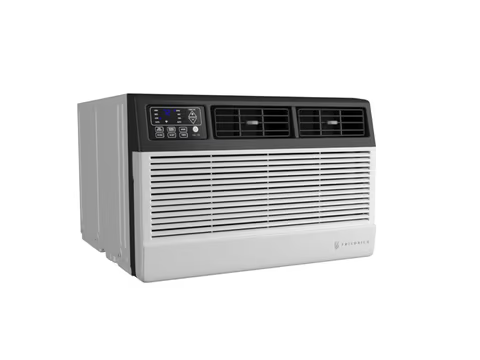
That permanence cuts both ways. It means no seasonal install, a sealed fit that leaks less air than a window kit, and windows that stay windows. It also means a contractor or a confident DIYer, a stud-safe location, and a decision you live with for a decade. If you already have a sleeve — most common in apartments and older buildings — the calculus flips entirely: measure it, and the Friedrich Uni-Fit is built to slide into 24.5–27 in. sleeves already in the wall.
The efficiency and noise tax, in numbers
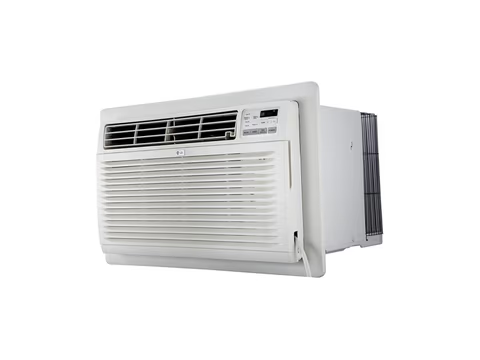
Efficiency: every wall unit we track is a fixed-speed compressor. The best, the LG LT1016CER, is 10.6 CEER (9,800 BTU, ~450 ft², ~$549, ENERGY STAR). The Frigidaire WallFit and Keystone 14K are 10.5; the Friedrich 10.1; the Koldfront and GE 9.5–9.6. Against the 15.0–15.2 CEER of the LG and Dreo window inverters, that is roughly 40% more electricity for identical cooling — real money in a high-rate state, as our state-by-state cost table shows.
Noise: the quietest wall unit is the Friedrich Uni-Fit at 54 dB (its QuietMaster dampening is the reason it costs ~$799 for 8,000 BTU). The LG wall unit is 56, the Keystone 57, the Frigidaire 59, the GE 60, and the Koldfront 62. The best window inverters idle at 42–44 dB — and because decibels are logarithmic, 54 vs 44 is not “a bit louder,” it is several times the sound energy. For a bedroom, that alone decides it; see the quietest ACs ranking.
When the wall unit genuinely wins
You already have a sleeve. Replacing a dead wall unit is the easiest AC install there is — slide the new one in. Do not cut a window bracket into a room that already has a hole in the wall. You need the window. Egress rules, a fire escape, a view, or a landlord who forbids window units all point to the wall. You want heat too. The Koldfront (4,200 BTU supplemental electric heat) and the GE 12K Heat/Cool give year-round use from one hole — useful in shoulder seasons, though electric-resistance heat is costly to run daily. You want it to look permanent. A sleeved unit with a trim kit reads as part of the building, not a seasonal appliance.
Which through-the-wall unit to buy
Most rooms: the LG LT1016CER — best-selling for a reason: the group’s best efficiency, 9,800 BTU for ~450 ft², a standard 115V outlet, and a Gold Fin anti-corrosion coil (worth having near the coast). ~$549, 4.1★ across 850+ owners; cool-only, no app. Quietest / existing sleeve: the Friedrich Uni-Fit 8K — 54 dB, app + Alexa/Google, and the universal chassis that fits most sleeves already in the wall. Premium at ~$799 for 8K. Bigger rooms: the Frigidaire WallFit 12K (12,000 BTU, ~550 ft², still 115V, ~$570) or the Keystone 14K (14,000 BTU, ~700 ft², ~$600 — but it needs a 230V/20A outlet, so check your wiring first). Budget with heat: the Koldfront WTC8001W at ~$500 — accept that it is the loudest of the group at 62 dB.
The verdict
If you have a usable window and no sleeve, the honest answer is a window inverter — the LG LW1022IVSM or the Dreo U-Shaped will cost less to run every month and let you sleep. If you have a sleeve, need the window, or want the permanence, the LG LT1016CER is the wall unit to buy, and it is a perfectly good machine — just size it right first with the BTU calculator (an oversized wall unit short-cycles exactly like an oversized window unit), and see every spec side by side in the comparison table.
Featured units
Specs and running costs for the units referenced in this guide:
LG LT1016CER Through-Wall
Friedrich Uni-Fit 8K Smart
LG Dual Inverter LW1022IVSM
Frequently asked questions
What is the difference between a through-the-wall and a window air conditioner?
A window AC sits in an open window on a bracket and can be removed; a through-the-wall AC slides into a metal sleeve set permanently into an exterior wall, so it vents straight out the back and leaves your windows free. The wall unit is a permanent install (you cut the wall once); the window unit is seasonal and reversible. Wall units also lag on efficiency and noise: the ones we track run 9.5–10.6 CEER at 54–62 dB versus 15 CEER and 42–44 dB for the best window inverters.
Are through-the-wall air conditioners more efficient than window units?
No — in our catalog it is the reverse. The most efficient wall unit we track is the LG LT1016CER at 10.6 CEER; the best window units are dual-inverters at 15.0–15.2 CEER, roughly 40% more efficient for the same cooling. Wall units are fixed-speed compressors sized around sleeve dimensions, and no mainstream through-wall model has caught up to inverter efficiency yet.
Can I put a window air conditioner through the wall?
Usually not, and the reason matters: most window units vent through side louvers that a wall sleeve would block, and their chassis is not designed to be sealed into masonry. Some are marketed as “window or wall” with a specific sleeve — check the manual for an approved wall kit before assuming. Otherwise, buy a true through-the-wall unit and match it to a sleeve.
Do through-the-wall air conditioners need a sleeve?
Yes — the sleeve is the structural, sealed box in the wall that the unit slides into, and it is usually sold separately (the Koldfront and Friedrich in our catalog both note this). If you are replacing an old wall unit, measure the existing sleeve first: the Friedrich Uni-Fit is built specifically to slide into 24.5–27 in. sleeves already in the wall, which is the cheapest path.
Which is better for a bedroom?
The window inverter, clearly. Even the quietest wall unit we track — the Friedrich Uni-Fit at 54 dB — is louder than the loudest of the top window inverters (44 dB), and decibels are logarithmic. If the room is a bedroom and you have a usable window, the wall unit’s permanence is not worth its noise.
Not sure what size you need?
Our calculator factors in climate, sun, and insulation — and estimates your monthly running cost.
Run the BTU calculator