-480x360.png)
The short answer
For a bedroom or studio where noise decides everything, the GE Profile ClearView is the quietest window unit we track at 41 dB on low — its saddle design hangs the compressor below the sill, outside the closed glass. The U-shaped Dreo DR-HAC002 is right behind at 42 dB for ~$349, and it is far more efficient.
Renting an apartment with no window for a chassis unit? The quietest portable we track is the Hisense 8K dual-hose inverter at 42 dB. And if you own your place and want another league entirely, a ductless mini-split runs 19–28 dB — quieter than a whisper. Every dB figure below is the manufacturer low-fan spec, verified against the documentation in our comparison table.
What the decibel numbers actually mean
Decibels are logarithmic: roughly every 10 dB feels twice as loud. So the gap between a 42 dB unit and a 52 dB unit is not "ten percent louder" — it is about twice the perceived noise. For reference: 19–28 dB is whisper-to-rustling-leaves territory, 40–45 dB is a quiet library, 50–55 dB is a running refrigerator, and 60 dB is normal conversation.
Two fine-print rules when you read spec sheets. First, the advertised number is almost always the lowest fan speed — expect 5–10 dB more on high. Second, compressor character matters as much as level: a fixed-speed compressor slamming on at 2 a.m. wakes you even at moderate dB, which is why every unit on this page is an inverter.
Why the quietest ACs are all inverters
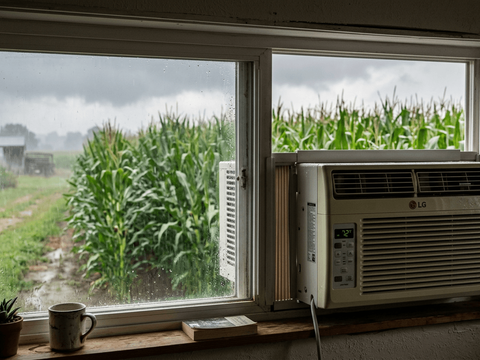
The loudest moment of a conventional AC is the compressor kicking on — a jolt, a hum shift, then full blast until it overshoots and shuts off, over and over all night. An inverter compressor ramps smoothly and then cruises at partial speed, so there is no start-up jolt and the steady-state hum sits far lower. The same engineering that makes these units 30–40% cheaper to run makes them the only ones worth shortlisting for a bedroom — our inverter window AC guide covers that side of the story.
The second trick is compressor placement: U-shaped and saddle-style window units hang the compressor outside the closed pane, so the glass itself becomes a sound barrier. That is how the two quietest window units on this page beat conventional chassis designs by 3–10 dB.
How we picked
We track 49 units with specs verified against manufacturer documentation and DOE filings. For this guide we ranked by the low-fan decibel spec, then required inverter operation and a solid owner-review record, and weighed efficiency and price — and nothing else. Prices are typical street prices; treat them as a guide, not a quote.
Quietest window ACs: GE Profile ClearView, then the Dreo
The GE Profile ClearView AHTT08BC is the quietest window unit we track: 41 dB on low, 8,300 BTU for ~350 ft², with app and voice control. Its below-the-sill saddle design also keeps your window view. The honest trade-off is efficiency — at 11.4 CEER it costs noticeably more to run than the inverter competition, so buy it for the silence and the view, not the power bill.
The Dreo U-Shaped DR-HAC002 gives up almost nothing in noise (42 dB) and fixes the efficiency problem: 15 CEER at ~$349, the best quiet-per-dollar in the category. No app — remote and dials only. The Friedrich Chill Premier 8K matches 42 dB with premium build and smart control at 12 CEER. Want quiet and top efficiency and app control in one chassis? The 44 dB LG Dual Inverter LW1022IVSM (10K BTU, 15 CEER) is the do-everything compromise — still bedroom-quiet, and our overall window pick.
Quietest portable: Hisense dual-hose inverter
Portables are the loudest category because the compressor sits in the room with you — but inverter dual-hose designs close most of the gap. The Hisense 8K dual-hose inverter idles at 42 dB with an excellent 13.5 CEER at ~$330, and the Midea Duo MAP14S1TBL matches 42 dB with more cooling headroom (14K BTU for ~550 ft²). Either is as quiet as a good window unit — rare praise for a portable. For the full portable field, see the best portable ACs guide.
The silence ceiling: mini-splits at 19–28 dB
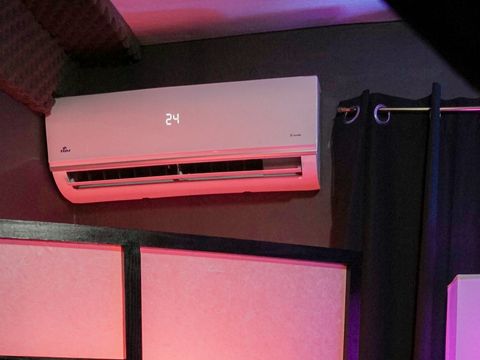
If you own your home and quiet is the top priority, no window or portable unit competes with a ductless mini-split: the compressor lives entirely outside, so the indoor head is just a slow fan over a coil. The Mitsubishi MZ-GS12NA reaches an astonishing 19 dB — below a whisper — and the budget favorite Senville LETO 12K runs 28 dB at ~$799 plus installation. The trade-offs are upfront cost and a professional install (or a DIY-rated kit). Our mini-split vs window AC comparison walks through when the jump is worth it.
Five ways to make any AC quieter tonight
1. Kill the rattle: most "loud AC" complaints are vibration, not the compressor. Tighten the mount, add a support bracket, and make sure the side curtains and foam seals are snug so the frame cannot buzz against the window.
2. Run low or auto fan — that is the spec-sheet number. 3. Right-size the unit: an oversized AC short-cycles, repeating the loudest moment all night; the BTU calculator sizes your room in a minute. 4. Damp portables with a rug or rubber pads under the wheels. 5. If you are replacing anyway, buy inverter — see the quiet-focused picks in our window guide and the full comparison table with every dB spec side by side.
Featured units
Specs and running costs for the units referenced in this guide:
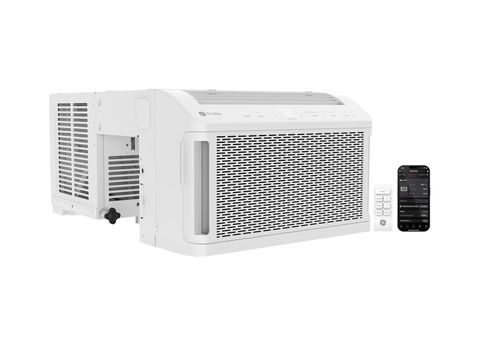
GE Profile ClearView AHTT08BC
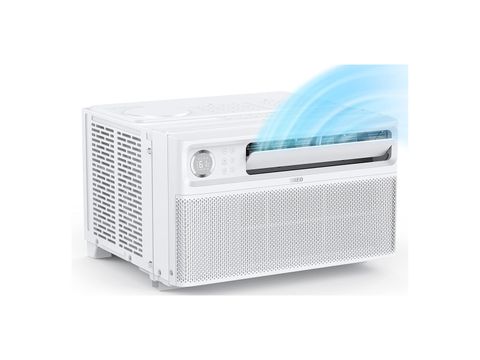
Dreo U-Shaped 8K DR-HAC002
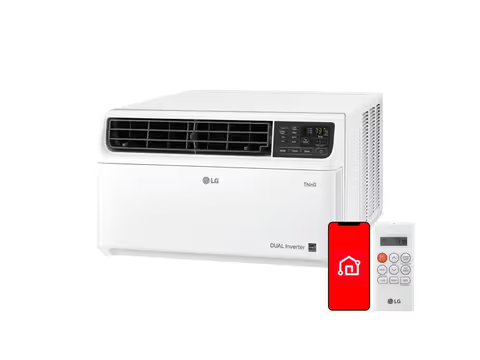
LG Dual Inverter LW1022IVSM
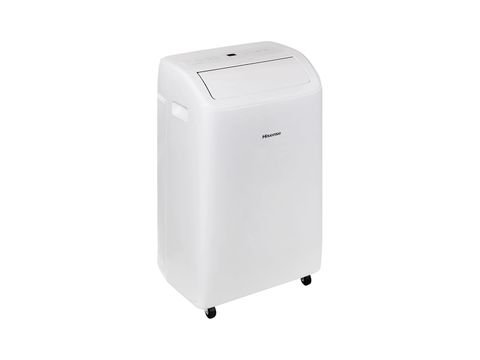
Hisense 8K Dual-Hose Inverter
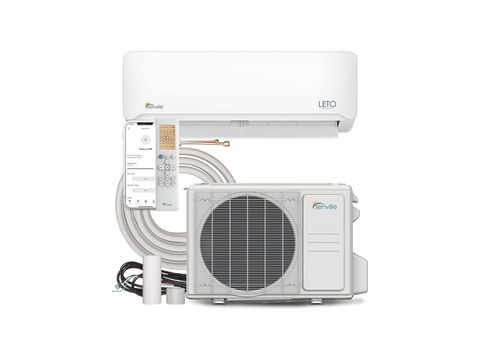
Senville LETO SENL-12CD
Frequently asked questions
How many decibels is a quiet air conditioner?
For a bedroom, look for 45 dB or lower on the low fan setting — roughly library-quiet. Standard window and portable units run 52–58 dB, which is closer to a normal conversation and noticeable when you are trying to sleep. The quietest window units we track reach 41–44 dB, and ductless mini-splits drop to 19–28 dB.
What is the quietest type of air conditioner?
A ductless mini-split, and it is not close: the indoor head holds only a fan and coil while the compressor sits entirely outside, so the best units run 19–28 dB — quieter than a whisper. Among window units, saddle and U-shaped designs are quietest (41–42 dB) because the closed window blocks the compressor. Portables are the loudest type since the whole machine is in the room.
What is the quietest window air conditioner?
Of the units we track, the GE Profile ClearView is the quietest window unit at 41 dB on low — its saddle design hangs the compressor below the sill outside the closed glass. The U-shaped Dreo DR-HAC002 is right behind at 42 dB and costs less, while the LG Dual Inverter models hit 44 dB with better efficiency (15+ CEER).
Are portable air conditioners louder than window units?
Generally yes, because the compressor sits inside your room with nothing blocking the sound. A typical portable runs 55–60 dB. The exceptions are inverter dual-hose models: the Hisense 8K dual-hose and the Midea Duo both idle around 42 dB — as quiet as the best window units.
How can I make my air conditioner quieter?
Four things help most: tighten the mounting so the frame cannot rattle (a support bracket helps), seal side gaps with the foam kit so vibration is not amplified, run the low or auto fan speed, and pick an inverter unit — its compressor ramps gently instead of slamming on at full power. For portables, a rug or rubber pads under the wheels damp floor vibration.
Not sure what size you need?
Our calculator factors in climate, sun, and insulation — and estimates your monthly running cost.
Run the BTU calculator