The short answer
Wi-Fi does not make an air conditioner more efficient. It can make it run less — and that is where every dollar it saves comes from. Scheduling and geofencing stop the unit cooling an empty room; a remote off-switch catches the AC you forgot. Those are real savings on a fixed-speed unit that otherwise blasts at full power for hours. On an inverter, which idles at partial power once the room is cool, the compressor already captured most of the saving and the app is mostly convenience.
So the honest ranking of what lowers an AC bill is: right size, then efficiency, then hours. Wi-Fi only touches the third. Our smart window AC guide picks the units; this explainer puts numbers on the “does it pay” question.
Where the electricity actually goes
An AC’s draw while running is set by two things: its size (BTU) and its efficiency (CEER — cooling delivered per watt). An 8,000 BTU unit at CEER 15 draws about 533 watts; the same cooling at CEER 11 draws about 727 watts. Nothing in an app changes those numbers. What the app changes is the third factor in the bill — hours — and only if you use it to run the unit less. Our CEER explainer covers the efficiency side; the cost-to-run guide has the full watts × hours × rate formula.
The math: what scheduling is worth
Take our standard model — 8,000 BTU, 8 hours a day, 30 days, at the May 2026 U.S. average residential rate of 18.44¢/kWh. A CEER 11 budget unit costs about $32 a month; a CEER 15 inverter about $24. Now let the app cut two empty-house hours a day — a quarter of the runtime. On the budget unit that saves about $8 a month; on the inverter, about $6 — but the inverter was already idling at partial power for much of those hours, so its real-world saving is smaller than the arithmetic suggests. Cut a full workday and the budget-unit saving roughly triples. Two conclusions follow: the app is worth most on the cheapest, least efficient units, and your habits set the ceiling, not the hardware. In a high-rate state the same hours are worth far more — the state-by-state cost table shows New York at nearly double the national figure and Hawaii at nearly triple.
Fixed-speed vs inverter: why it changes the answer
A fixed-speed compressor is either fully on or off, so every hour it runs in an empty room is a full-power hour — that is exactly what scheduling eliminates. An inverter modulates down to a fraction of full power once the setpoint is reached and just holds it, so leaving it on in an empty room costs a fraction of what a fixed-speed unit does. That is why the best inverters save money whether or not you touch the app, and why on a unit like the Midea U or the LG LW1022IVSM the Wi-Fi is best thought of as convenience you get for free. On a fixed-speed smart unit like the Hisense 10K (11.4 CEER, ConnectLife app), the schedule is where the money is.
What Wi-Fi is genuinely good for
Pre-cooling: start it 20 minutes out instead of running it all day or arriving to a hot room. Geofencing/scheduling: the one feature that lowers the bill. The remote check: confirming it is off from wherever you are — a saving every time you would otherwise have left it running. Voice: convenience, not savings. What none of it does is substitute for buying the right size or a decent CEER — the BTU calculator and the CEER explainer handle those, and they are worth more than any app.
The verdict
If you are choosing between two units, do not pay a premium for Wi-Fi expecting it to cut the bill — pay for CEER and the right size, which cut it every hour the unit runs. Then treat Wi-Fi as a tie-breaker, and use it: a schedule that actually turns the AC off when the house is empty is the only part of “smart” that shows up on the statement. The good news is that the best inverters now include it anyway, so on the units we recommend you are not choosing between efficiency and control — you get both.
Featured units
Specs and running costs for the units referenced in this guide:
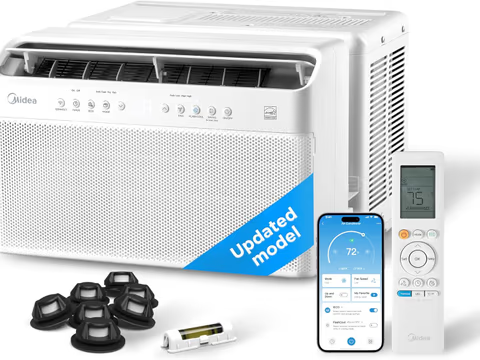
Midea U MAW08V1QWT
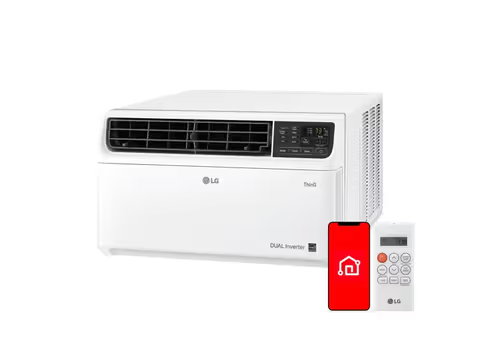
LG Dual Inverter LW1022IVSM
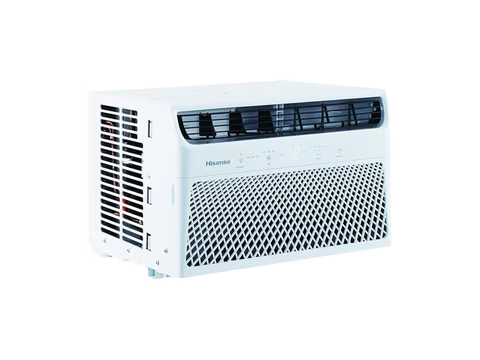
Hisense AW1022CW1W Smart
Frequently asked questions
Does a smart AC use less electricity?
Not while it is running. The compressor and the unit’s CEER rating decide how much power it draws for a given amount of cooling, and Wi-Fi changes neither. A smart AC saves electricity only by running fewer hours — through scheduling, geofencing, or you switching it off remotely — so the saving is real but behavioral, not mechanical.
How much money can scheduling an AC save?
Roughly in proportion to the hours you cut. Using our cost model — an 8,000 BTU unit at 8 hours a day at the May 2026 U.S. average of 18.44¢/kWh — a budget CEER 11 unit costs about $32 a month. Trim two empty-house hours a day (a quarter of the runtime) and you save about $8 a month; a full workday of scheduling saves proportionally more. Your state moves those figures a lot; the state-by-state cost table has the local numbers.
Is a smart AC worth it if I have an inverter?
For savings, less so; for convenience, yes. An inverter idles at partial power once the room is cool, so leaving it on costs far less than leaving a fixed-speed unit on — the compressor already captured most of the saving. On an inverter the app is mainly pre-cooling, remote checks and voice control. Fortunately the best inverters (Midea U, LG Dual Inverter) include Wi-Fi anyway.
Is a smart plug a cheaper alternative?
It is cheaper but it is not an alternative. A smart plug can only cut power, which stresses a running compressor and usually leaves the unit idle when power returns rather than resuming cooling. It cannot set temperature or modes. Use one as an energy monitor if you like; do not use one as the control system.
What actually lowers an AC bill the most?
In order: buying the right size (an oversized unit short-cycles and wastes power), buying an efficient unit (a CEER 15 inverter uses roughly a quarter less electricity than a CEER 11 budget unit for the same cooling), then reducing hours with scheduling. Wi-Fi helps with the third; the first two are decided when you buy.
Not sure what size you need?
Our calculator factors in climate, sun, and insulation — and estimates your monthly running cost.
Run the BTU calculator