The short answer
Florida cooling is a moisture problem first and a temperature problem second. Miami and Tampa summers routinely run 70–90% humidity, and an air conditioner only removes water while its coil is cold and air is moving across it. So the unit that keeps a Florida room comfortable is the one that runs long and steady rather than blasting and stopping — which means: an inverter, sized to the room (never above it), ideally with a real dry mode.
Our picks on those criteria: the Midea U MAW12V1QWT (12,000 BTU inverter, 15 CEER, 42 dB) for most Florida bedrooms and living rooms, the LG Dual Inverter LW1022IVSM (10,000 BTU) for mid-size rooms, and the LG LW1522IVSM 14K inverter for open-plan spaces. For state-specific sizing and what cooling costs at Florida’s rates, our Florida AC guide has the local numbers.
Why humidity changes the rules
Two loads hit an AC: the sensible load (lowering air temperature) and the latent load (condensing water vapor). In a dry climate the latent load is trivial; in Florida it can rival the sensible load. The catch is that a compressor only condenses moisture while it is running — so a unit that satisfies the thermostat quickly and shuts off has done the temperature job while barely touching the water. That is the physics behind the classic Florida complaint: cold but clammy. Long, low run-times are the fix, and that is precisely what an inverter compressor does by design.
The one mistake to avoid: oversizing
Everywhere else, an oversized AC is merely wasteful. In Florida it is actively worse: it short-cycles, hitting the setpoint in minutes and stopping before meaningful dehumidification happens, so you get a cold, damp room and a unit that cycles all day. The instinct to “buy extra power for the heat” is exactly backward here. Size to the room with the BTU calculator — it adjusts for climate — and if you are between two sizes, choose the smaller one. Our sizing guide explains the full method, and the short-cycling troubleshooter covers what to do if you already own an oversized unit.
Inverter vs fixed-speed in a humid room
A fixed-speed compressor is either fully on or off, so its dehumidification is bursty — strong while running, zero while resting. An inverter modulates down to a fraction of full power once the room is near setpoint and just keeps going, coil cold, air moving, water draining. In humid air that continuous low run is worth more than any spec on the box — and it is also why inverters are quieter and cheaper to run. Every primary pick below is an inverter for that reason. The inverter guide explains the technology; the CEER explainer covers what the efficiency numbers mean.
The picks
Best overall for Florida: Midea U MAW12V1QWT — 12,000 BTU of inverter cooling for ~550 ft² at 15 CEER and 42 dB, with app, Alexa/Google and scheduling, ~$419, 4.5★ across 15,000+ owners. The inverter runs long and low, the U-shape lets the window close onto it, and 12K covers the typical Florida living room without oversizing it. One honest note from our data: earlier units were covered by a 2025 recall — buy the current updated version.
Best for mid-size rooms: LG Dual Inverter LW1022IVSM — 10,000 BTU for ~450 ft², 15.0 CEER, 44 dB, ~$429, 4.6★ across 2,800+ reviews. Our overall window pick, and its dual-inverter modulation is exactly what a humid bedroom wants.
Best for open-plan spaces: LG LW1522IVSM 14K — 14,000 BTU across ~800 ft² while still idling at 44 dB, 14.7 CEER, ~$529. The rare large unit that modulates instead of blasting; note the middling 3.9★ owner rating and volatile Amazon pricing.
Budget pick with a real dehumidification spec: Keystone KSTAW12CE — 12,000 BTU for ~550 ft², a rated 2.5 pints/hour of dehumidification, a follow-me temperature-sensing remote, ~$360, 4.3★ across 1,800+. It is fixed-speed (12 CEER, 58 dB), so it will not match the inverters on steady humidity control — but it is the best of the budget class for a damp room, and it costs less than half what a large inverter does.
Florida-specific buying notes
Salt air: coastal Florida corrodes coils. Look for anti-corrosion coatings — the LG through-wall LT1016CER’s Gold Fin coil is the kind of spec that matters within a few miles of the ocean — and rinse the outdoor-facing coil each spring. Portables: single-hose units pull humid outdoor air back in through every gap; if you must go portable, choose dual-hose — see the portable AC guide. Mini-splits: for whole-home humidity control an inverter mini-split is the gold standard, and Florida’s long season repays the install cost faster than almost anywhere — the mini-split vs window comparison lays out the trade. Running cost: at Florida’s 15.17¢/kWh an efficient 8K unit runs about $19 a month for 8 hours a day — but Florida runs it far more months than most states, which is why the inverter’s efficiency compounds here. Full numbers in the state-by-state cost table.
Featured units
Specs and running costs for the units referenced in this guide:
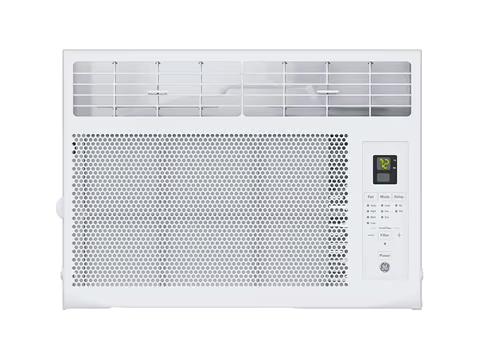
Midea U MAW12V1QWT
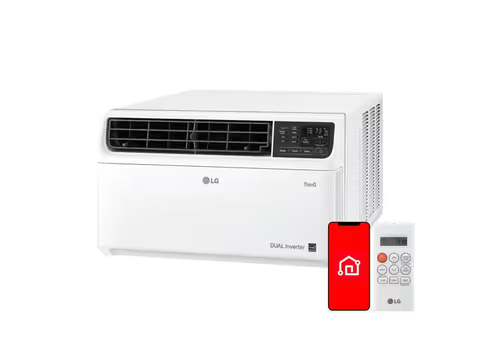
LG Dual Inverter LW1022IVSM
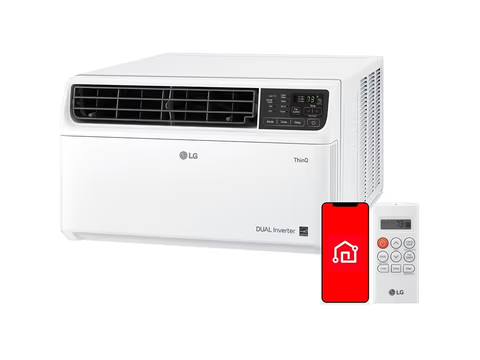
LG Dual Inverter LW1522IVSM 14K
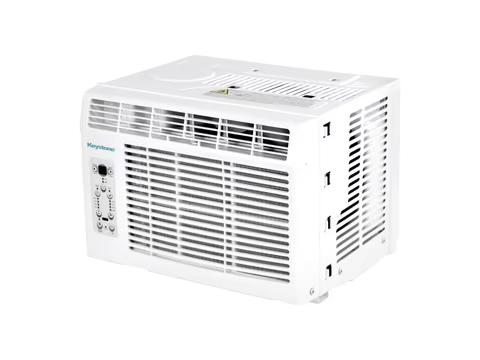
Keystone KSTAW12CE
Frequently asked questions
What is the best type of air conditioner for humid climates like Florida?
An inverter (variable-speed) unit, sized to the room rather than above it. Dehumidification happens only while the coil is cold and air is moving across it, so a unit that runs long and steady at partial power pulls far more water out than a fixed-speed unit that blasts, hits the setpoint, and shuts off. Inverters do exactly that. Among window units, the Midea U 12K and LG Dual Inverter LW1022IVSM are the ones we would put in a Florida room first.
Why does my AC leave the room cold but sticky?
It is oversized. A too-big unit cools the air to the setpoint in a few minutes and shuts off before it has run long enough to condense much moisture, so the temperature drops but the humidity does not — cold and clammy. In Florida this is the single most common mistake. Size to the room with our calculator, and if you are between sizes, go smaller.
Does dry mode actually work?
Yes, within limits. Dry (dehumidify) mode runs the compressor with the fan slowed down, so air lingers on the cold coil and sheds more moisture per pass while cooling less. It is genuinely useful on the wet, mild Florida days when you want the stickiness gone but do not need much cooling. It is not a substitute for a dedicated dehumidifier in a chronically damp space like a garage.
Is a portable AC good for Florida humidity?
Generally the weakest choice. Single-hose portables pull room air to cool the condenser and exhaust it outside, which drags humid outdoor air back in through every gap. If a portable is your only option, choose a dual-hose model. Otherwise a window or wall unit — or a mini-split — will control humidity far better.
What size AC do I need in Florida?
Slightly less than the generic rule suggests, not more. Standard sizing is roughly 20 BTU per square foot; in humid climates the temptation is to round up for “extra power,” and that is exactly what causes clammy rooms. Use our BTU calculator with your Florida location — it adjusts for climate — and pick the closest size, rounding down if you are between two. Our Florida page walks through the local specifics.
Not sure what size you need?
Our calculator factors in climate, sun, and insulation — and estimates your monthly running cost.
Run the BTU calculator