The short answer
Buy a window unit if you are renting, on a budget, or cooling a single room for a few months a year — it is cheap, needs no installation, and comes out in winter. Buy a mini-split if you own your home, want the lowest running cost and quietest operation, need year-round heating and cooling, or want to condition a room with no suitable window.
The trade-off is simple: a window unit costs a few hundred dollars and minutes to install; a ductless mini-split costs several times more but pays you back in lower bills, far less noise, and a heat pump that works in winter too.
Upfront cost
A quality window AC runs roughly $150–600 depending on size and whether it has an inverter compressor. A ductless mini-split is $700–2,000 for the equipment and $1,500–4,000 installed by a contractor — the bulk of that difference is professional installation: mounting the indoor head, setting the outdoor condenser, and running and vacuuming the refrigerant lines.
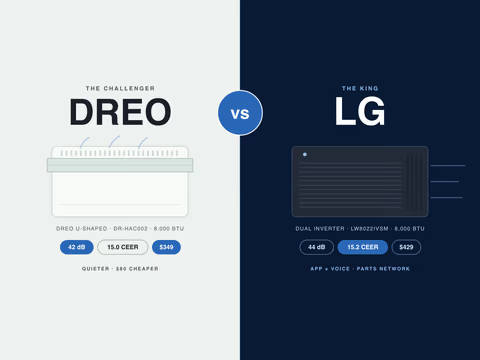
DIY mini-split kits like the MRCOOL DIY close part of that gap with pre-charged lines you connect by hand, putting a mini-split within reach of a confident homeowner for around $1,000–1,500 total. You can compare specific models side by side on price and efficiency.
Efficiency and running cost
This is where the mini-split wins decisively. Modern ductless units use variable-speed inverter compressors and reach 18–30 SEER2, while most window units land around 10–15 CEER. In practice a mini-split can cut cooling costs 30–50% versus an older fixed-speed window unit over a long season — the inverter runs long and low instead of blasting and short-cycling.
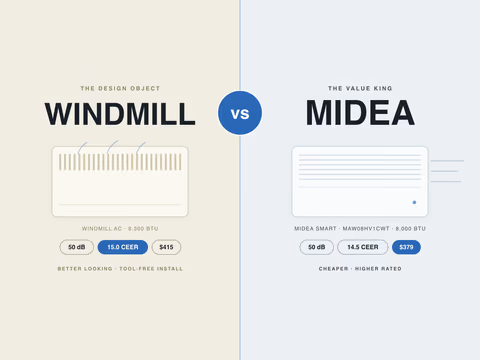
Inverter window units narrow the gap and are the smart middle ground for renters. To understand the ratings, see our explainer on what SEER2 and CEER actually mean, or estimate your own bill with the running-cost guide.
Installation and the window question
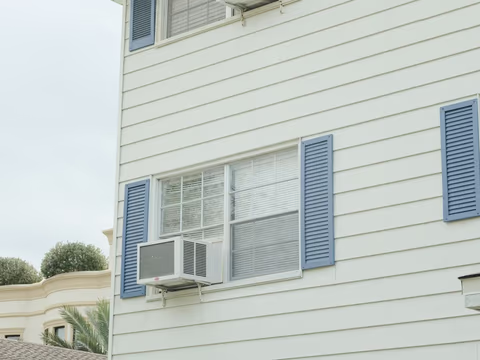
A window unit installs in minutes and needs only a suitable window and a nearby outlet — but it blocks that window, and some leases or HOAs restrict them. A mini-split needs only a three-inch hole in an exterior wall, so it works in rooms with no window, with awning or casement windows, or in finished basements where a window unit will not fit.
Professional mini-split installation is the norm and is worth it for a proper refrigerant connection and warranty. If you would rather hire it out, you can find a licensed local HVAC pro in our directory.
Noise and comfort
A window unit puts the compressor in the room with you — even quiet models hum at 50–55 dB and cycle on and off all night. A mini-split keeps the compressor outside, so the indoor head is whisper-quiet (often under 30 dB) and the variable-speed compressor holds a steadier temperature without the cold-blast-then-silence cycle of a window unit.
For a bedroom or home office, that difference in noise and temperature stability is the most-cited reason owners say the mini-split was worth it.
Mini-splits heat, too
Almost every mini-split is a heat pump, so it heats about as efficiently as it cools — often well below freezing with a cold-climate model. A window AC only cools. In a mixed or northern climate, a mini-split can replace or supplement electric baseboard or a space heater and earn its keep year-round, which changes the cost math entirely.
Which should you buy?
Choose a window unit for renting, tight budgets, seasonal use, or a single room you can fit one in — see our picks for the best window ACs. Choose a mini-split for owned homes, year-round comfort, the lowest bills, quiet bedrooms, multi-room zoning, or windowless rooms.
Whichever you pick, size it to the room first with the BTU calculator — an oversized unit of either type short-cycles, leaves the air humid, and never reaches its rated efficiency.
Featured units
Specs and running costs for the units referenced in this guide:
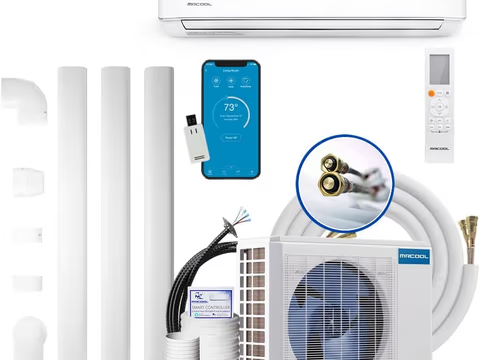
MRCOOL DIY 4th Gen 12K
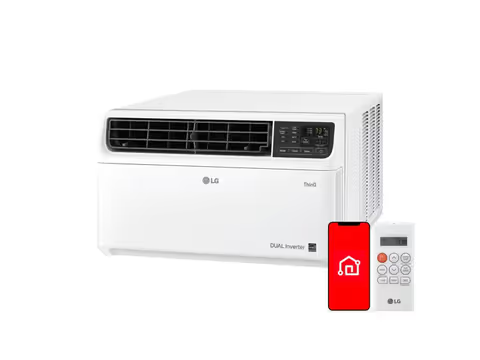
LG Dual Inverter LW1022IVSM
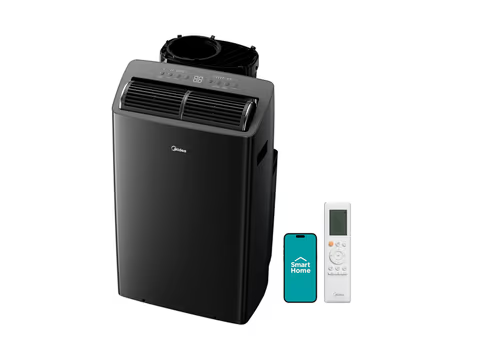
Midea Duo MAP12S1TBL-A
Frequently asked questions
Is a mini-split better than a window unit?
For efficiency, noise, comfort, and year-round use, yes — a mini-split is quieter, can cut cooling costs 30–50%, and heats as well as cools. A window unit wins on upfront price, renter-friendliness, and simplicity. The right choice depends on whether you own the home and how long your cooling season is.
Can I install a mini-split myself?
A standard mini-split needs professional installation to connect and vacuum the refrigerant lines. DIY kits like the MRCOOL DIY use pre-charged lines you connect by hand, which a confident homeowner can install in an afternoon — otherwise a licensed pro is the safe route and protects the warranty.
Are mini-splits worth the extra cost?
If you own your home and run cooling (or heating) for much of the year, usually yes: the lower bills, far lower noise, and year-round heat-pump operation repay the higher upfront cost over time. For a renter cooling one room for a few summer months, a window unit is the more sensible spend.
Do mini-splits heat as well as cool?
Almost all of them do — they are heat pumps, and cold-climate models keep heating efficiently well below freezing. A window AC only cools, so a mini-split's ability to handle winter is a major part of its value in mixed and northern climates.
Which is cheaper to run, a mini-split or a window AC?
A mini-split, by a wide margin. Its variable-speed inverter compressor and higher SEER2 rating typically use 30–50% less electricity than an older fixed-speed window unit over a season. An inverter window unit closes much of that gap and is the efficient choice if a mini-split is not an option.
Not sure what size you need?
Our calculator factors in climate, sun, and insulation — and estimates your monthly running cost.
Run the BTU calculator