How we picked
We track 18 window units with specs verified against manufacturer documentation and DOE efficiency filings. These picks are ranked on CEER efficiency, low-speed noise, owner-review patterns, and street price — and nothing else. Prices are typical street prices and move around; treat them as a guide, not a quote.
Best overall: LG Dual Inverter LW1022IVSM
The LG LW1022IVSM is the unit we recommend most: 10,000 BTU covering ~450 ft², a class-leading 15 CEER, and a dual-inverter compressor that idles at 44 dB — quiet enough to sleep next to. App and voice control are built in, and it routinely sells around $429.
If your room is smaller, the same engineering comes in an 8,000 BTU size: the LG LW8022IVSM posts an even better 15.2 CEER for ~350 ft² rooms at the same price point.
Best value for quiet: Dreo U-Shaped 8K
The Dreo DR-HAC002 undercuts the big brands at ~$349 while matching their efficiency (15 CEER) and beating most on noise: the U-shaped design leaves the compressor outside the closed window, so you hear as little as 42 dB. The trade-off is no app control — a remote and dials only.
Prefer a designer look over raw value? The Windmill AC delivers the same efficiency with the best-looking face in the category and tool-free install, at a ~$415 street price.
Best budget: Frigidaire FFRA051WAE
At roughly $169, the Frigidaire FFRA051WAE is America's default small-room AC — 5,000 BTU for ~150 ft², mechanical dials that survive decades, and tens of thousands of positive owner reviews. It's louder (around 57 dB) and there's no remote, but nothing touches its cooling-per-dollar for a dorm, office, or small bedroom.
Best for large rooms: LG LW1521ERSM
Open-plan space or a whole floor? The LG LW1521ERSM pushes 15,000 BTU across up to 800 ft² with ThinQ app control. Check your electrical circuit and window dimensions first — 15K-class units are heavy, and many need a dedicated 15A circuit to run happily.
Before you buy: the 60-second checklist
Size the room first — an oversized unit short-cycles, leaves the air clammy, and wastes money. The BTU calculator adjusts for your climate, sun exposure, and insulation in under a minute.
Then sanity-check three specs: CEER (15+ is excellent, 11 is budget-grade), low-speed noise (under 45 dB for bedrooms), and the window kit (measure your window opening — U-shaped and saddle units have different requirements than standard chassis). The full field is in our comparison table.
Torn between two specific units? We break the closest matchups down head-to-head: LG vs Windmill, LG vs Midea, Windmill vs Midea, Dreo vs LG, and — if you are weighing a permanent install — through-the-wall vs window.
Featured units
Specs and running costs for the units referenced in this guide:
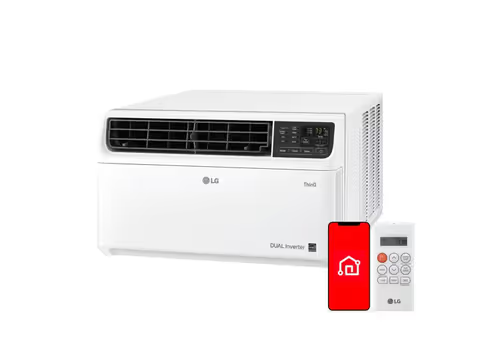
LG Dual Inverter LW1022IVSM
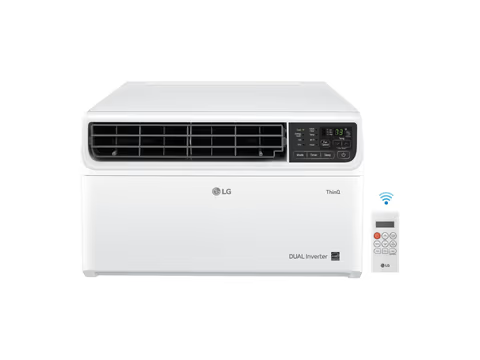
LG Dual Inverter LW8022IVSM
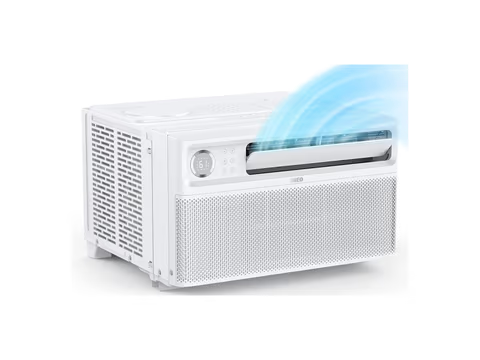
Dreo U-Shaped 8K DR-HAC002
Frigidaire FFRA051WAE
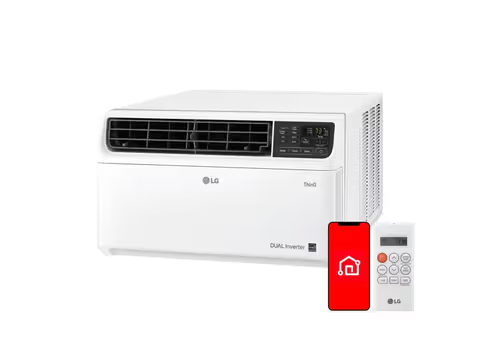
LG LW1521ERSM 15,000 BTU
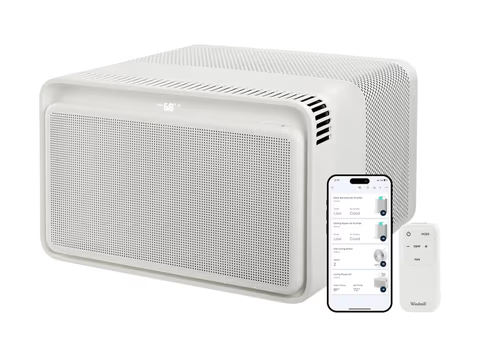
Windmill AC
Frequently asked questions
Is an inverter window AC worth the extra money?
Usually, yes. Inverter (variable-speed) compressors run continuously at low power instead of cycling on and off: roughly 25–40% lower energy use, dramatically quieter nights (44 dB vs 55+), and steadier temperatures. At ~$100–150 over a fixed-speed unit, a full-season bedroom unit typically earns it back within two summers.
What size window AC should I buy?
Size to the room, not the price tag: roughly 20 BTU per square foot, adjusted for climate, sun, and insulation. A 10,000 BTU unit covers ~450 ft² in average conditions. Our calculator does the adjusted math in 60 seconds — oversizing is the most common (and most regretted) mistake.
Can I install a window AC myself?
Almost always. Units up to ~10,000 BTU are a one-or-two-person job with the included mounting kit; 12,000+ BTU units get heavy (some 100+ lb) and benefit from a support bracket and a second pair of hands. Renters: use a no-drill bracket and keep the packaging.
Not sure what size you need?
Our calculator factors in climate, sun, and insulation — and estimates your monthly running cost.
Run the BTU calculator